
Have you ever walked through a show home and felt that electric moment when you think “this could actually be mine”?
That’s the feeling driving thousands of people across Dublin right now. New home developments are appearing faster than anyone predicted. Empty fields transform into entire neighborhoods within months. Communities spring up with schools, parks, and cafes before the last houses even finish construction.
I watched this transformation firsthand when my sister started house hunting last year. She visited 14 different new builds across Dublin before finding her place. Some developments promised everything but delivered basic boxes. Others exceeded expectations so completely that waiting lists stretched months ahead.
The difference between a smart purchase and an expensive regret often comes down to knowing what questions to ask before signing anything. And if you’re considering areas with strong amenities, guides like the best views in Dublin can help you get a feel for neighbourhood quality before you commit.
This guide covers everything about buying new homes in Dublin. From understanding different schemes and pricing to choosing the right location and developer, you’ll know exactly what to look for when visiting show homes across the city.
You can also follow Dublinz Facebook and Dublinz Instagram to join the community and get regular Irish updates!
Top New Home Developments Dublin (December 2025)
| Development | Location | Price Range | What Makes It Special |
| Seven Mills | Dublin 22 | €380,000-€545,000 | Major new town development, Kishoge train station access, 225 acres green space |
| Balmoston | Donabate | €345,000-€525,000 | Coastal town living, 10-min walk to train, A-rated Glenveagh homes |
| Montpelier | Dublin 7 | Affordable scheme prices | 1,046 homes total, 3km from O’Connell Street, mixed tenure community |
| Lockhouse Way | Seven Mills, Dublin 22 | €400,000+ | Houses, apartments, duplexes, beside Kishoge station |
Understanding New Home Prices in Dublin Right Now
The new homes Dublin property market moves differently than the second-hand market. Developers release homes in phases, meaning prices can shift between releases even within the same development. A three-bedroom house might cost €480,000 in phase one, then jump to €510,000 in phase two just months later.
As of December 2025, price ranges across Dublin break down roughly like this. Entry-level two-bedroom homes in outer areas like Lucan or Adamstown start around €345,000 to €390,000. Mid-range three-bedroom family homes in established commuter towns run €440,000 to €550,000.
Premium four-bedroom properties in south Dublin locations like Kilternan or Rathfarnham climb from €750,000 past €1 million. These ranges shift regularly as developers release new phases, so treat these as guideline figures rather than current quotes.
I learned about these price jumps from a colleague who hesitated on a Swords property last spring. He wanted to think about it over the weekend. By Monday, that entire phase sold out. The next release came €25,000 higher per unit. That weekend of thinking cost him real money.
Understanding how developers price their releases helps you move decisively when you find the right property. Show home visits create urgency for good reason. These aren’t tactics to pressure you. They’re realities of how new build Dublin developments actually sell.
Major New Housing Developments Dublin 2025
Seven Mills
Seven Mills represents something genuinely remarkable happening in Dublin 22. This isn’t just another housing estate. Developers are creating an entire town from scratch along the Grand Canal.
Since the first residents moved in late 2023, the community has grown rapidly with hundreds of families now calling Seven Mills home. The development is on track to become one of Dublin’s largest new communities, with population growth continuing throughout 2025 and 2026.
Once fully developed, Seven Mills will become a substantial new town comparable in scale to established communities across Dublin. It spreads across 225 acres featuring dedicated biodiversity areas supporting local plants and wildlife. Parks and play zones connect through walkways and cycle paths. A scenic 3.5 kilometre canal frontage runs through the community.
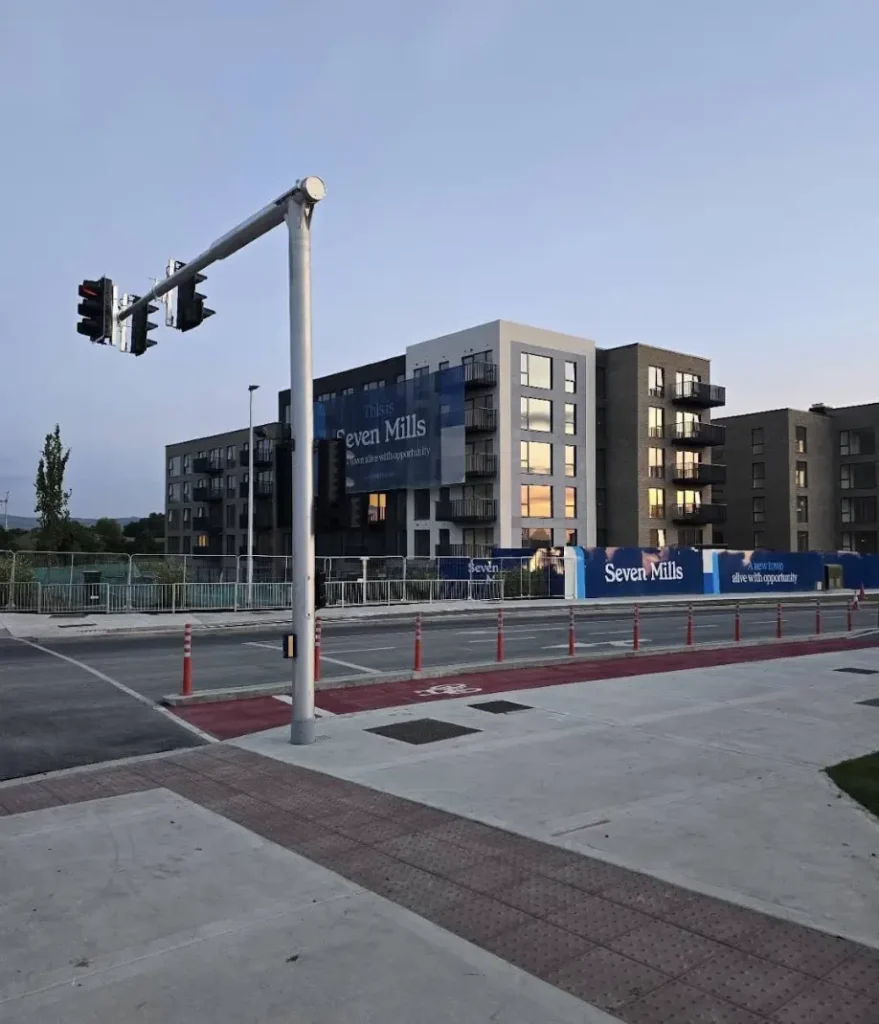
Kishoge train station opened recently, offering residents direct transport into Dublin city centre. Construction continues on Cooper Square, the first mixed-use phase featuring retail, commercial spaces, and 608 apartments that will become one of Europe’s largest Passive House developments.
Lockhouse Way launched as the newest residential section featuring houses, apartments, and duplexes. Properties in this Seven Mills development range from €400,000 up to €545,000 depending on size and type. The first commercial outlet, DASH Café, already serves residents, with more amenities opening throughout 2025 and 2026.
Every home sits within two minutes of open green space. That design choice makes Seven Mills feel less cramped than typical Dublin housing estates where green areas become afterthoughts rather than central features.
Balmoston
Balmoston brings new homes to Donabate, a small seaside town in north Dublin with blue flag beaches and scenic coastal walks. Glenveagh Homes developed this collection of A-rated one, two, three, and four-bedroom properties ranging from approximately 52 square metres to 164 square metres.
Prices run €345,000 to €525,000 for market-rate purchases. Fingal County Council also partners with Glenveagh to provide affordable purchase homes under special schemes for eligible buyers.
The train station sits just 10 minutes on foot from the development. Residents can catch direct trains into Dublin city centre or connect to the wider commuter network. Donabate itself offers local schools, sports facilities, cafes, and restaurants within the immediate area.
Newbridge House & Farm occupies over 370 acres of parklands nearby with playgrounds, gardens, a museum, and cafe. Donabate Beach, Portrane Beach, the Donabate Cliff Walk, and Turvey Nature Reserve all provide outdoor recreation options that make coastal living genuinely appealing rather than just marketing talk.
One person I know from work moved to Balmoston last autumn. She specifically mentioned how the coastal walks and beach access transformed her daily routine. She started running along the cliff path most mornings, something she never did living in Drumcondra. The lifestyle shift made the longer commute worthwhile for her family.
Montpelier
Montpelier stands as one of Dublin’s most significant regeneration projects. Located on the former O’Devaney Gardens site in Dublin 7, this landmark development will deliver 1,046 A-rated new homes through partnership between Dublin City Council, Bartra, and Tuath Housing.
The location sits just 3 kilometres from O’Connell Street, making it one of the most centrally positioned new developments in Dublin. The scheme includes new parks, community spaces, shops, a crèche, a pharmacy, and a GP practice designed to foster genuine community rather than just creating housing units.
Following the successful launch of 66 affordable homes earlier in 2025, the first residents are scheduled to begin moving in from February 2026, with the entire first phase completing in June 2026. This phase will deliver 379 social, affordable, and cost-rental homes across mixed tenure. As with all construction projects, exact timelines may be subject to change.
Affordable purchase home applications open periodically throughout the development phases, with past rounds typically accepting submissions over 3-4 week windows. Eligible applicants must meet specific income and first-time buyer criteria. Register with Dublin City Council’s affordable homes portal for alerts about upcoming application windows.
Montpelier demonstrates what public-private partnerships can achieve when focused on delivering quality housing in thriving neighbourhoods rather than just hitting unit numbers.
Affordable Housing Schemes Explained
New homes Dublin market includes several schemes making homeownership accessible to buyers who wouldn’t qualify for traditional mortgages on market-rate properties.
The Local Authority Affordable Purchase Scheme lets councils make new homes available at reduced prices. In return, the council takes a percentage equity share in your property. When you eventually sell, the council receives their share of any profit based on their equity percentage.
Eligibility requires being over 18, typically a first-time buyer unless meeting Fresh Start Principle exceptions, and your purchasing power cannot exceed 95% of the home’s market value. Income thresholds vary by property type, council area, and change annually. For example, three-bedroom homes have specific income caps that differ from two or four-bedroom properties. Always verify current income limits with your local authority before applying, as these figures are updated regularly.
Cost Rental offers long-term rental with secure tenancy at affordable rates. Rents are set on calculations covering construction, management, and maintenance costs rather than market rates. Tuath Housing operates several Cost Rental developments across Dublin.
Applications for affordable schemes typically open for limited periods with high demand. Missing application windows means waiting months or longer for the next opportunity. Following council websites and affordable housing portals helps you catch announcements when new phases launch. Many buyers also look at nearby amenities before applying, and guides such as Dublin’s best shopping centres can help you understand what daily life around a new development might feel like.
Choosing the Right Location for Your New Dublin Home
Location shapes everything about your daily life after moving in. The perfect new build in the wrong location creates years of frustration. The adequate new build in the right location often proves the smarter choice.
Think about your actual daily routine rather than theoretical preferences. Do you commute to Dublin city centre five days weekly? Proximity to train stations or quality bus routes matters more than an extra bedroom. Are you working remotely most days? Walkable amenities like cafes, parks, and shops become daily necessities rather than weekend luxuries.
North Dublin developments like Balmoston, Swords, and Malahide offer coastal access and strong transport links via train. South Dublin locations including Rathfarnham, Dundrum, and Kilternan command premium prices but deliver established amenities and mature neighbourhoods.
West Dublin areas such as Lucan, Adamstown, and Clondalkin provide better entry-level pricing with ongoing infrastructure improvements. Dublin 22 developments like Seven Mills represent major investment in creating entirely new communities from scratch.
My nephew and his partner spent months debating between a larger house in Adamstown versus a smaller place in Dundrum. They eventually chose Dundrum despite the size compromise. The decision came down to her parents living nearby and both of them working in Sandyford. The daily commute time savings added up to hours each week they could spend together rather than sitting in traffic.
Nobody can tell you which location suits your life best. But thinking through actual daily patterns rather than abstract preferences makes the choice clearer.
What to Look for During Show Home Visits
Show homes are designed to sell. They’re styled beautifully with furniture scaled to make rooms feel spacious. The lighting hits perfectly. Fresh flowers sit on tables. Everything looks magazine-ready.
Your job during visits is seeing past the styling to evaluate the actual property. Bring a measuring tape and note the room dimensions. That gorgeous sitting room might actually be quite compact once you imagine your own furniture filling the space.
Check the building quality by examining door frames, window seals, and finish work around skirting boards. Quality builds show attention to detail in these small elements. Rushed construction reveals itself through gaps, uneven joins, and sloppy paint work.
Ask about the Building Energy Rating. A-rated homes cost significantly less to heat and power compared to older ratings. With energy prices staying high, that efficiency translates to real money saved monthly.
Question the developer about the completion timeline for surrounding amenities. Some developments promise shops, cafes, and community centres that won’t materialise for years. Others deliver amenities in early phases before most homes even finish construction.
Visit the broader area at different times. Drive or walk the route you’d use for your commute during rush hour. Check if local schools have capacity. Visit nearby shops to see what’s actually available versus what the brochure suggests.
I walked through a stunning show home in west Dublin last year with my sister. The property looked perfect. Then we drove to the area on a Tuesday evening during rush hour. The traffic getting to the nearest motorway entrance backed up for 40 minutes. She crossed that development off her list immediately. That test drive saved her from years of commute frustration.
New Build vs Second-Hand: Making the Right Choice
New homes Dublin developments offer clear advantages over older properties. You receive a full Building Energy Rating showing exactly what your energy costs will be. Modern insulation standards mean lower heating bills throughout ownership.
Snag lists get addressed by developers under warranty. If something goes wrong in the first year, you have recourse through the builder rather than paying out of pocket for repairs. Ten-year structural guarantees through HomeBond or similar schemes provide additional protection.
Everything is new. You’re not inheriting someone else’s DIY disasters, hidden problems, or deferred maintenance. The first person to use that bathroom, kitchen, and garden is you.
Second-hand properties counter with immediate availability, established gardens, mature trees, and settled neighbourhoods where community already exists. You can view the exact property you’re buying rather than imagining based on plans or show homes.
Prices per square metre often favour second-hand properties in established areas. A four-bedroom house in Drumcondra might cost less than a new three-bedroom in Seven Mills despite the older home offering more space.
The Help to Buy scheme currently provides tax rebates up to €30,000 for eligible first-time buyers purchasing new builds, though scheme limits and eligibility criteria are subject to government review and change.
Your decision ultimately depends on what matters most. If energy efficiency, warranties, and modern design top your priorities, new builds deliver those benefits. If location flexibility, immediate move-in, and established communities matter more, the second-hand market offers advantages.
Questions to Ask Before Signing Anything
Never let excitement push you into signing contracts before understanding every detail. Developers employ professional sales teams trained to create urgency and excitement. That’s their job. Your job is protecting your interests.
Ask when the development will actually complete. Delays happen constantly in construction. Weather, supply chain issues, and labour shortages push timelines back. If you need to move by a specific date, build in buffer time or consider other options.
Confirm what’s included in the base price versus optional extras. Fitted wardrobes, upgraded flooring, landscaping, and even basic appliances sometimes cost extra. The advertised €450,000 property might actually cost €470,000 once you add everything you assumed was standard.
Understand the management company structure and annual fees. New developments require ongoing management for common areas, insurance, and maintenance. Management fees can run €1,200 to €2,400 annually depending on amenities. Factor those costs into your budget.
Check if any affordable or social housing is included in the development. Mixed tenure communities bring benefits through diversity but some buyers have concerns. Understanding the mix upfront prevents surprises later.
Request information about soundproofing between units in apartments or terraced houses. Modern building regulations require minimum standards but quality varies between developers.
Find out about parking allocation. How many spaces come with your property? Are they deeded or unassigned? Can you get extra spaces if needed?
Ask these questions in writing and request written responses. Verbal assurances mean nothing if problems arise after closing.
Moving Forward With Your New Home Purchase in Dublin
Buying new homes in the Dublin market requires balancing speed with caution. Properties sell quickly when priced fairly and located well. Hesitating too long means losing out to other buyers ready to commit.
Start by getting mortgage approval in principle before viewing properties. Knowing your budget prevents falling in love with homes you can’t afford. It also strengthens your position when making offers on in-demand developments.
Register with estate agents handling developments that interest you. Knight Frank, Sherry FitzGerald, Hooke & MacDonald, and others represent major developers. Getting on their mailing lists means early notification when new phases launch.
Visit multiple developments across different areas before deciding. The first show home always feels exciting. The fifth or sixth visit gives you perspective about what good quality actually looks like versus clever staging.
Trust your instincts about developers. Some companies deliver consistently high quality with transparent processes. Others cut corners and create problems for buyers. Online reviews, speaking with existing residents, and checking the developer’s track record helps identify which category they fall into.
New homes in Dublin represent major purchases with decade-long implications. Taking time to research, ask questions, and think through decisions pays off through years of satisfaction in your new home.
Verify Before You Buy
This guide reflects December 2025 market conditions. Property prices, affordable scheme eligibility criteria, application deadlines, and construction timelines change frequently in Dublin’s dynamic market.
Specific figures mentioned throughout this guide—from development prices to income thresholds—serve as examples of late 2025 conditions rather than guaranteed current details.
Before making any financial commitments or property decisions, verify all information directly with:
- Development sales teams for current pricing and availability
- Local authority housing departments for scheme eligibility and application windows
- Independent financial advisors for mortgage and affordability guidance
- Solicitors for legal aspects of contracts and purchases
The property market never stops moving. Neither should your due diligence!
FAQs About New Homes Dublin
What is the average price for new homes in Dublin?
New homes Dublin prices vary significantly by location and size. Entry-level two-bedroom properties start around €345,000 in outer areas. Three-bedroom family homes typically range €440,000-€550,000 in commuter towns. Premium four-bedroom homes in south Dublin can exceed €1 million. Prices increase between development phases as builders release homes in stages.
How do I apply for affordable housing schemes in Dublin?
Affordable housing scheme applications open for limited periods through local council websites like affordablehomes.dublincity.ie. You must meet eligibility criteria including first-time buyer status, income thresholds, and purchasing power limits. Applications typically stay open 2-4 weeks with high demand. Register for council alerts to catch new announcements early.
Are new builds worth the extra cost compared to older homes?
New builds offer A-rated energy efficiency reducing monthly bills, full warranties covering defects, Help to Buy tax rebates up to €30,000 for first-time buyers, and modern layouts designed for contemporary living. Older homes provide established neighbourhoods, mature gardens, immediate availability, and sometimes better value per square metre. Your priorities determine which option suits you better.
Which Dublin areas have the most new home developments?
Dublin 22 including Seven Mills and Adamstown features major ongoing development. North Dublin areas like Swords, Donabate, and Malahide offer coastal new builds. West Dublin locations including Lucan and Clondalkin provide entry-level pricing. South Dublin sites like Kilternan and Rathfarnham deliver premium properties. Dublin 7’s Montpelier brings new homes to inner city locations.
How long does it take from reservation to moving into a new Dublin home?
Completion timelines vary by development phase. Completed show homes allow moves within 6-8 weeks after contract signing. Properties under construction typically take 6-12 months to complete. Developments just breaking ground may require 18-24 months before move-in. Always ask developers for specific completion dates and build delays into your plans.
Comments are closed.